Background on Acoustic Applications
Measuring and analyzing sound waves traveling through air, solids, and liquids is important to many industries involved in production testing, machine/engine performance, and process control. Signals detected by sensors such as microphones and accelerometers can reveal critical information about an object's behavior and actions. Sound waves can also be used for acoustic localization through active techniques where sound is generated and the echo is studied accordingly, whereas passive methods can only be used by listening to the sound or vibration generated and then trying to determine the direction and location of the sound source. Perhaps the best known acoustic localization method is SONAR, in which water listeners are used to monitor waveforms traveling through water. However, acoustic localization is also used in other media and plays a key role in materials science and geology.
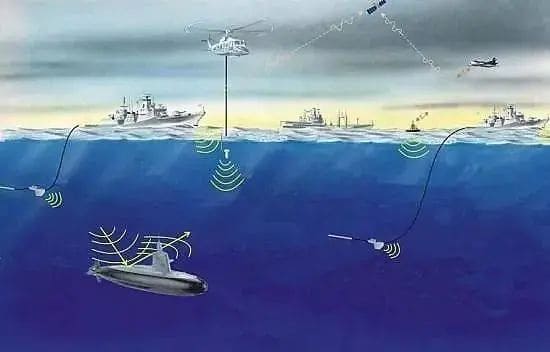
Typical acoustic applications include acoustic ranging, acoustic localization, sonar, seismology, acoustic emission, vibration analysis, engine testing, process control, ocean acoustic tomography and bioacoustics.
Honghong Spectrum Program
Using the latest PC-based technology, Spectrum's digitizers and arbitrary waveform generators are excellent tools for the development, testing and operation of acoustic systems. They are compact and offer a wide range of bandwidths and sampling rates so that measurement needs are best met. HighResolution Digitizers offer 16-bit performance with extreme accuracy and low noise. These cards have excellent signal-to-noise ratios (up to 90 dB) and noise-free dynamic ranges (up to 115 dB)The front-end design further extends the dynamic range by providing up to eight different full-scale ranges (from ±50 mV to ±10 V) and a wide range of bias functions. The dynamic range is further extended by the front-end design, which offers up to eight different full-scale ranges (from ±50 mV to ±10 V) and a wide range of bias functions.
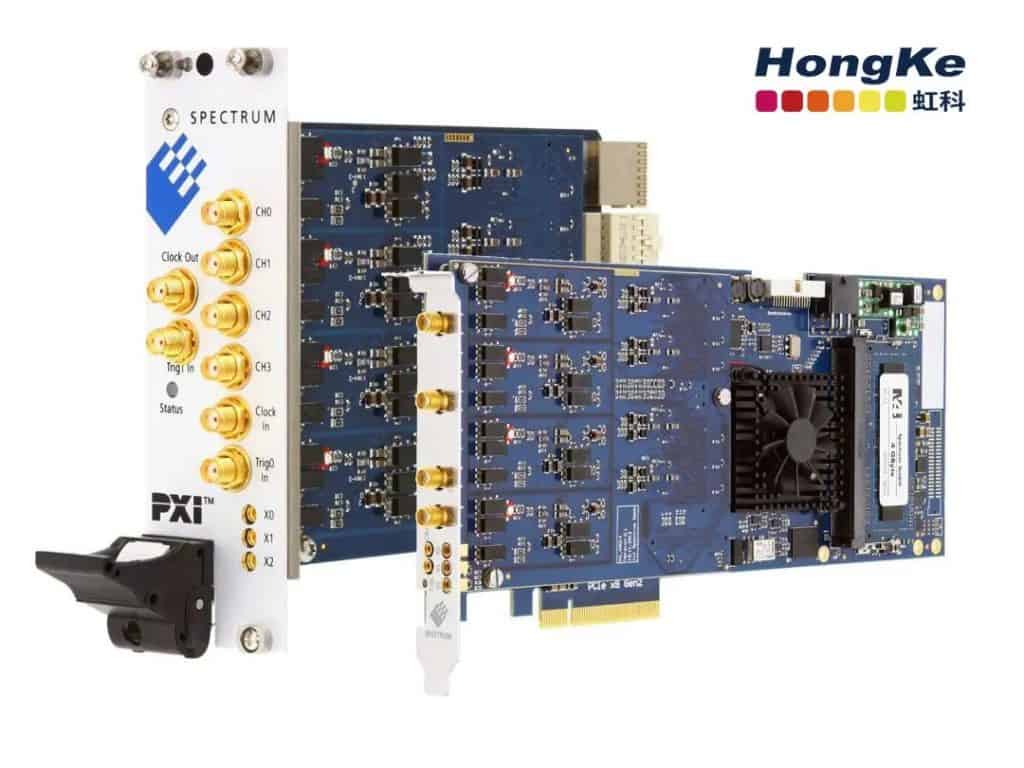
Each digitizer card can have from one to sixteen channels, with a maximum ofUp to sixteen StarHub systems can be connected to the Spectrum.The StarHub system can be used to create instruments with up to 256 fully synchronized channels, making it suitable for applications with multiple sensors and sensor arrays. If necessary, larger systems can be created by linking StarHub systems together to build systems with thousands of fully synchronized channels.
These cards also come with large on-board memory (up to 1 G samples per card), advanced data streaming modes, and read modes for capturing and transmitting signals. The card's data streaming mode allows data to be transferred to RAID-based storage arrays via PCIe or PCI bus for days of information capture and storage. The Spectrum's SBench 6 software can also be used to view and characterize signals. FFTs can be used for frequency domain analysis and power measurements, while parameter calculations help determine key signal characteristics such as amplitude, frequency, pulse width and period.
Board Series
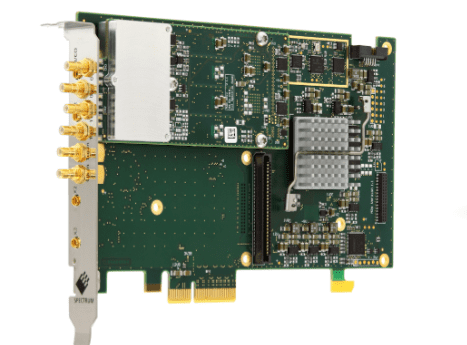
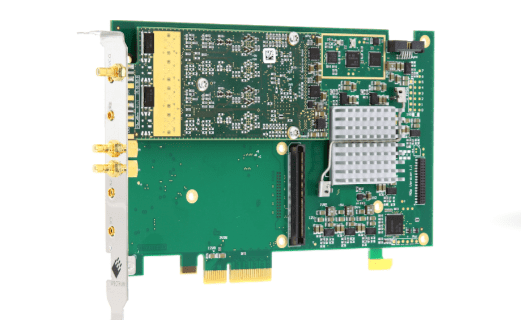
Spectrum Product Features
l Sampling rate up to 5 MS/s
l Very low signal-to-noise ratio and SFDR
l Segmented Memory with FIFO Readout
l SBench 6 software for control display and analysis
l differential input
l 8 input ranges from ±50 mV to ±10 V at full scale
l Star-Hub function for realizing full synchronization of multiple channels