
I. Preface
In high-speed digital communication, precision measurement and various embedded systems, how to accurately evaluate the performance of ADCs (analog-to-digital converters) in real-world environments has always been a core concern for R&D teams and test engineers.Especially when test scenarios require simulating highly complex, repeatable, and standardized input sequences, conventional sources often fail to adequately reflect the dynamics of the actual application. In this case PRBS (Pseudo Random Binary Sequence) It becomes a reliable and indispensable testing tool for engineers.
What is PRBS and why can't engineers live without it?
PRBS is a pseudo-random binary sequence of 0s and 1s, which has statistical properties similar to those of real random signals, but generates identical sequences by fixing the initial seed and repeating it with the return polynomial. pThe core features of RBS include the following:
1. Stochastic Characteristics
The statistical distribution of the sequence (e.g., 0/1 ratio, bit flip rate) is close to the real random signal, which can effectively simulate complex scenes.
2. Repeatability
Sequences can be fully reproduced with the same seed and return multiple items, which is suitable for design verification and cross-platform comparison.
3. Spectrum width
The PRBS has a broadband spectrum that extends to the Nyquist limit of the ADC and can be used to verify high frequency response.
4. Various sequence lengths
The common PRBS-7, PRBS-15, PRBS-23, and PRBS-31 are all 2ⁿ-1 in length. The longer the sequence, the richer the spectrum, and the more likely it is to avoid measurement errors caused by repetitive sequences.
Therefore, PRBS is especially suitable for high-speed, broadband, and dynamic test scenarios, such as high-speed ADCs, SerDes interfaces, optical signal receivers, and computer-machine interfaces.
Application of PRBS in ADC Testing

I. High-speed ADC Dynamic Performance Test
Applications:High-speed data acquisition cards, RF receivers, radar systems
1. Core Test Indicators
Verify SNR (Signal-to-Noise Ratio), THD (Total Harmonic Distortion), SFDR (Spurious Free Dynamic Range), ENOB (Effective Number of Bits).
2. Why is it necessary to use PRBS for high-speed ADCs?
PRBS (Pseudorandom Bit Sequence) covers a wide range of frequency components and provides complete coverage of the ADC input bandwidth, exposing defects in frequency domain response;The random feature avoids the chance of a single frequency signal and makes the test results more representative.Long code type PRBS (e.g. PRBS-31) can effectively minimize measurement errors caused by duplicate code types.
3. Typically applicable ADC types:
- Ultra-high-speed ADCs (sample rate ≥ 1 GS/s, e.g., 10 GS/s high-speed ADCs)
- RF ADC (Radio Frequency ADC)
Communication Interface ADC Test (SerDes / PCIe / USB4)
1. core test objectives:
Verify the integrity (eye diagram, jitter, BER) of high-speed interface signals such as SerDes, PCIe 5.0 / 6.0, USB4, etc.
2. Why do we need PRBS?
High-speed interface input signals are mostlyHigh jitter, high bandwidth (e.g., above 10 Gbps)The PRBS can simulate the high speed code streams of these types of actual code types to make the test closer to the real situation, and can verify the ADC's ability to restore various types of code types.
3. Typically applicable ADC types:
Dedicated ADC with integrated SerDes
Industrial Communication ADCs
Brain Computer Interface (BCI) Chip ADC Tests
1. core test objectives:
Verify the sampling accuracy and interference immunity of the ADC for weak brain signals such as EEG brainwaves.
2. Why do we need PRBS?
Neural signals typically have low amplitude (microvolts, about ±mV) and low frequency characteristics (below about 10 kHz).PRBS can simulate its stochastic and spectral characteristics.
Small amplitude PRBS (e.g. ±5 mV) corresponds to the true amplitude of the biometric signal, avoiding ADC saturation and improving test confidence.
3. Typically applicable ADC types:
Low-power, high-resolution BCI-specific ADCs (≥ 16-bit resolution)
Laser chip/optical communication ADC testing
1. core test objectives:
Verify the conversion performance of ADCs in optical communication links to high-speed optical signals (e.g., signal demodulation in optical modules).
2. Why do we need PRBS?
With the high bandwidth (up to 10 GHz or more) and high-speed switching characteristics of optical signals, PRBS simulates actual high-speed code streams with a spectrum that encompasses the broadband characteristics required for optical signals, which helps to validate the ADC's reduction capability, frequency response, and dynamic performance.
3. Typically applicable ADC types:
High-speed ADC for optical communication (sample rate ≥ 20 GS/s)
V. Industrial / Medical Sensor ADC Testing
1. core test objectives:
Verify the ADC's sampling accuracy and immunity to weak, noisy signals (e.g., pressure, temperature, bioelectric signals) output from various types of sensors.
2. Why do we need PRBS?
Sensor signals often contain noise components, nonlinearities, and complex spectra; PRBS can simulate a mixed "signal + noise" scenario.The bandwidth and frequency characteristics of the PRBS can be adjusted to match the output amplitude of different sensed signals (e.g., ±mV level of biopotential).
3. Typically applicable ADC types:
Noise-free, high-resolution sensing ADC (resolution ≥ 14-bit)
ATE automated test system (mass production stage)
1. core test objectives:
Provides standardized, repeatable stimulus signals for mass-produced ADCs to ensure consistent test results from batch to batch.
2. Why do we need PRBS?
PRBS is repeatable and quantifiable.Quickly loaded and configured via SCPI commands or test software (e.g. SBench 6).Supports automated processes in batch testing on ATE platforms such as Teradyne, Keysight, and others.
3. Typically applicable ADC types:
Mass production ADCs, dedicated on-chip ADCs
PRBS specific configuration reference in ADC testing
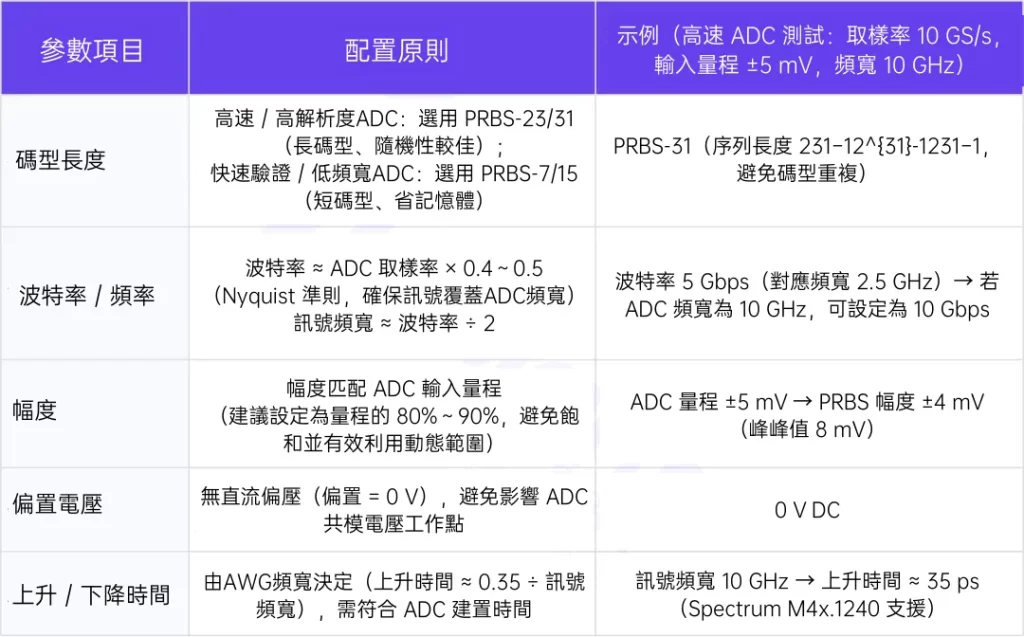
Notes on Testing: Four Keys to Avoiding Misdiagnosis
The size length should not be too short (e.g. PRBS-7).)
→ Incomplete frequency components are prone to SNR/SFDR reading bias.Range calibration cannot be omitted
→ Small-amplitude PRBS (e.g. ±5mV) are highly susceptible to noise and require AWG-calibrated outputs.Environmental and cabling impacts are huge
→ High-speed PRBS signals require a shielded, well-grounded test platform.AWG bandwidth must be greater than ADC bandwidth.
→ 10GHz ADC requires ≥12GHz AWG.
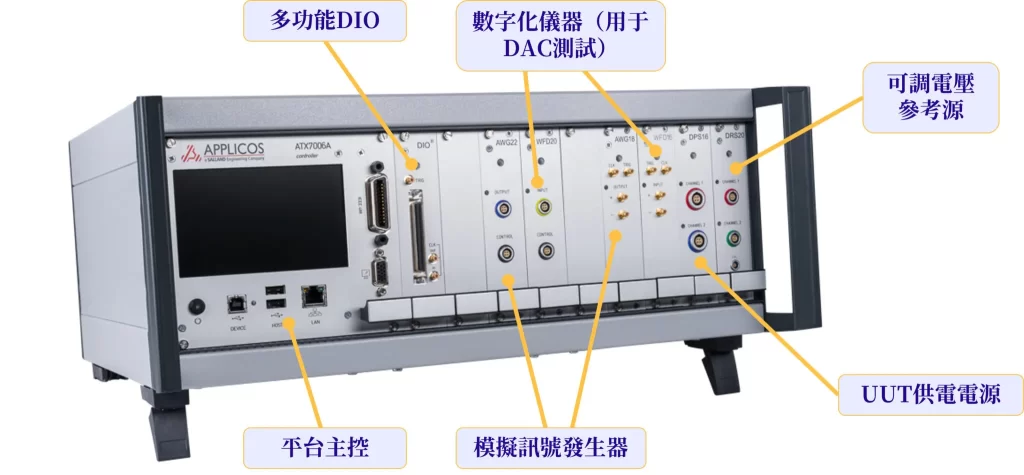
Honghong ADC/DAC chip test system: support full-scene PRBS verification.
The ADC/DAC test system is a modular ATE platform designed for wafer R&D and mass production:
✔ Support for in-depth dynamic performance testing
ADC/DAC Full-band Dynamic Indicator Measurement at Once
✔ Modularized Architecture
Expandable on demand for different stages of wafer testing
✔ High-speed DIO and Clock Module
Supports 8~24bit ADC/DAC, up to 400MHz sample rate.
✔ Complete SCPI control
Supports ATE automated scripting and multi-station production. → is the ideal platform for PRBS verification, high-speed ADC testing and wafer metrology.
Conclusion: Opening the Real World of ADC Testing with PRBS
Honghong ADC/DAC Test System
With the rapid evolution of high-speed computing, sensing, and communication technologies, the real test challenge is not just "whether you can measure the signal" but "whether you can accurately reveal the limits of the component in real-world applications".Repeatable, predictable and high bandwidthSequences of features that fully exploit the true capabilities of the ADC, revealing real-world performance in high noise, broadband and non-ideal environments.
From high-speed ADCs and optical receivers to brain-machine interfaces and industrial sensing chips, PRBS has become an indispensable standardized stimulus signal in various fields. The ADC/DAC test platform from ATEN is based onHigh precision, full frequency range and high consistencyThe core of the program is to assist the engineering team in conducting reliable performance verification during the R&D and mass production phases.
The real competition is not to run faster, but to be measured more accurately. Mastering PRBS is the key to bringing your product to market!
 想Get a more accurate picture of your ADC's true performance or evaluate the best configuration of PRBS for your existing test architecture?
Honghong provides high speed signal source,AWG, ADC/DAC test systems and ATE automated measurement platformsWe can help you complete the complete test process from R&D to mass production, and support customized sequences, measurement calibration and on-site application evaluation.
WelcomeContact UsWith the ADC/PRBS measurement demonstration and technical consultation, the test capability is fully upgraded to ensure that each of your wafers will perform at its best in real applications!
Learn more about our products
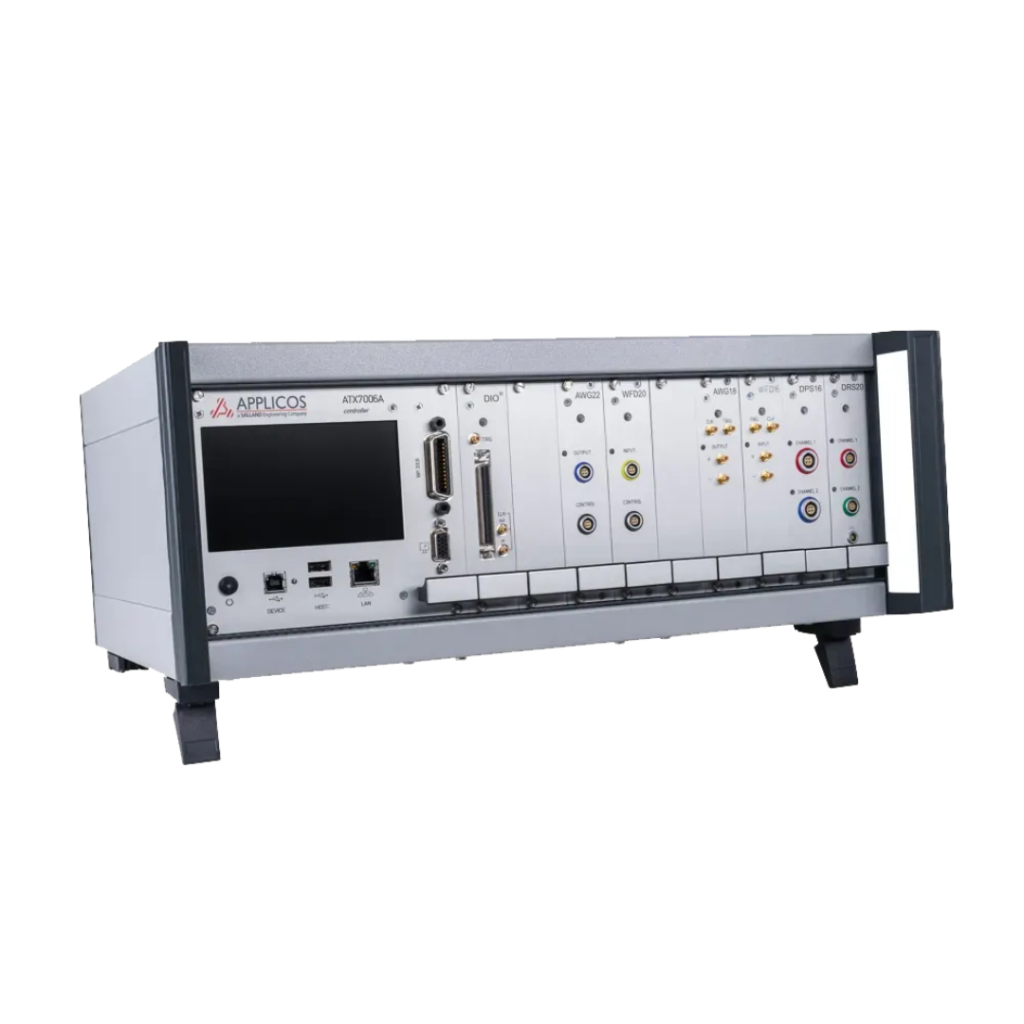
ADC/DAC Test System
9-slot ATE wafer test platform with modular design for flexibility and scalability
DIO clock synchronization module for 8-24 bit ADC/DAC measurement.
● Sampling rate of up to 400 MHz sets a new standard for efficient wafer testing
Honghong will provide you with any support you need!
Our professional Honghong team will be the first to respond and provide you with the best service to solve all your problems.