Application of Cryopreservation
I wonder if Members have read or heard of the novel "Three Styles".
One of the episodes is quite impressive. In the dark forest of the second part of the Trinity, there is a technology - cryogenic dormancy technology, that is, the target will be frozen and preserved, waiting for a few centuries after the highly developed human technology to wake up the target.
However, the use of cryogenic hibernation for human activity is not unique to "Three Stooges", as this type of technology appears in a number of classic sci-fi works, such as "Transmetropolitan Maniacs", "Star Trek", and "Deep Space Memory Loss".

Although they are called differently, the specific description of the operation is probably the same. It refers to freezing a human being in an extremely low environment for a very short period of time, so that the metabolism stops and the life cycle is extended indefinitely.
Cryogenic hibernation technology represents our vision of the future of wireless, including extended lifespan, interplanetary travel, and the treatment of terminal illnesses. As early as 1972, the Alcor Foundation was established, which performed the first human cryosurgery in 1976, and was the first human cryosurgery organization to be established. Currently, more than 100 people have been cryosurgically treated. According to Fortune magazine in the United States, Alcor's clients include many billionaires who have donated large sums of money to the foundation to subsidize its research on cryonics.
However, in terms of reality, the current development of cryobiology is still difficult to achieve the preservation of complete individuals as in science fiction movies, and it is still more at the cellular level of monomers, such as embryos, stem cells, mammalian cells, sperms, antisomes, tissue sections and mandibulate organs, etc. The development of cryobiology has also made it difficult to achieve the preservation of complete individuals as in science fiction movies, and it is still at the level of monomers.
Having talked about the application of cryobiology for so long, what is the exact definition of cryobiology?
Cyrobiology (低溫生物學) It includes a very wide range of contents, almost all the biological related experimental research or theoretical explorations carried out at temperatures lower than normal (suitable for survival of organisms) are within the scope of cryobiology.
It not only preserves the ultra-low temperature cryopreservation of the human body that we just mentioned in the sci-fi movie, but also includes cold chain food, vaccines, and so on. It can be summarized in 4 main areas.
- The use of cryogenics to treat diseases or produce drugs
- Research on the preservation (freshness) of biomaterials used as food under low-temperature conditions
- Research on the use of low-temperature conditions for the preservation of living biological materials (including cells, tissues, organs, embryos, and even whole organisms).
- and to study the impacts on the life processes of organisms under low-temperature conditions and the adaptation mechanisms of organisms to such impacts.
Q: Why is it possible to preserve biological samples at low temperatures?
The main reason is: water is the main ingredient in biological samples, and in the deep low temperature, i.e., the temperature is lower than -80℃, water exists in two physical ways: crystal state and glassy state. From the thermodynamic point of view, the water molecules of these two states have high viscosity, and will hardly expand. This property of water, which hardly spreads at low temperature, provides a possibility for the low-temperature preservation of biological samples.
B. Cryopreservation Methods
As mentioned before, there are two types of water at low temperatures: the crystalline state and the glassy state, and low-temperature preservation is also divided into two types: slow cooling and rapid cooling (vitrification).
Slow cooling preservationThe “two-step method” is usually adopted, that is, in the first step, the biological samples are first cooled down to -80℃ at a slower rate and maintained for a certain period of time, and then in the second step, the biological samples which are already at -80℃ are directly put into liquid nitrogen tanks (-196℃) for long-term preservation at deep cryogenic temperatures. The essence of the slow cooling method is to use a slower cooling rate, so that the water inside the cells is gradually detached from the cells during the cooling process, in order to minimize the probability of ice crystal formation inside the cells, and thus increase the survival rate of the cells. The advantage is that the concentration of cryoprotectant used is relatively low, only about 3%-20% is needed, but it is easy to cause cold damage and imbalance of osmotic pressure.
Rapid Cooling PreservationThe vitrification method is to use a high concentration of cryodilution solution to reduce the temperature at a very fast rate, so that the solution does not have enough time to form ice crystal nuclei directly into the process of the formless glass-like solid. The advantage of this method is that there is no need for a program-controlled thermoregulator, which makes the operation easy and fast and reduces damage. However, due to the need to add a large amount of cryoprotectant during the cooling process, which is as high as 40-60%v/v, there is often a certain degree of toxicity of this cryoprotectant that will kill the internal cells, and also due to the vitrification process, in order to ensure that the entire internal and external biological samples are able to achieve rapid cooling, it is necessary to At the same time, in order to ensure rapid cooling of the entire sample, both internally and externally, it is necessary to reduce the size of the sample and increase the contact area with the external ultra-low-temperature environment (e.g., liquid nitrogen). For the time being, this is only applicable to the preservation of small-sized and small-measurement biological samples, which are only available in ul units. Therefore, slow cooling is still commonly used for cryopreservation.
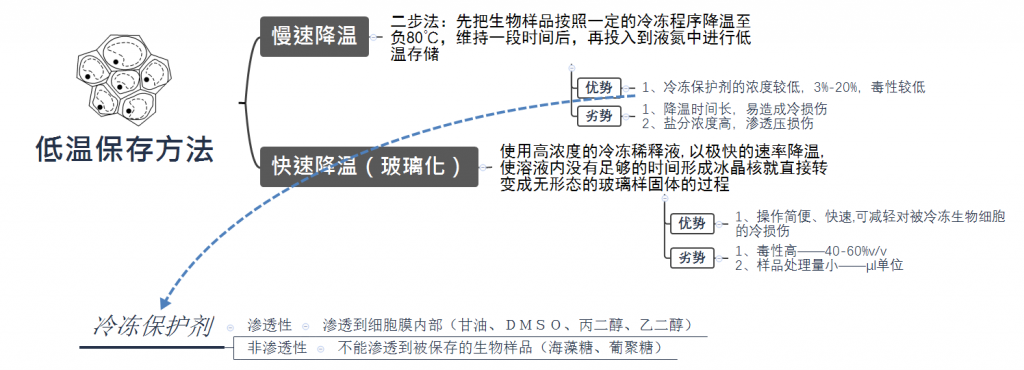
What is the cryoprotectant mentioned just now? Cryoprotectants are mainly used to minimize cold damage to cells during cryopreservation of biological samples. At present, the commonly used cryoprotectants are mainly divided into permeable cryoprotectants and non-permeable cryoprotectants.
Penetrating low-temperature protectantIt means that after the cryoprotectant is added to the cell suspension, it can penetrate into the cell membrane to replace the water in the cell. Osmotic cryoprotectants mainly include glycerol, DMSO, propylene glycol, ethylene glycol and so on.
Non-permeable low-temperature protective agentIt means that it cannot penetrate into the cell membrane. Common non-permeable cryoprotectants include alginate and dextran. In recent years, antifreeze proteins have also been used as a new type of cryoprotectant.
[Continues] - Next episode.Research on Cryopreservation Technology (II)】