1. Baseboard FPGA Clock Signal Trigger Synchronization
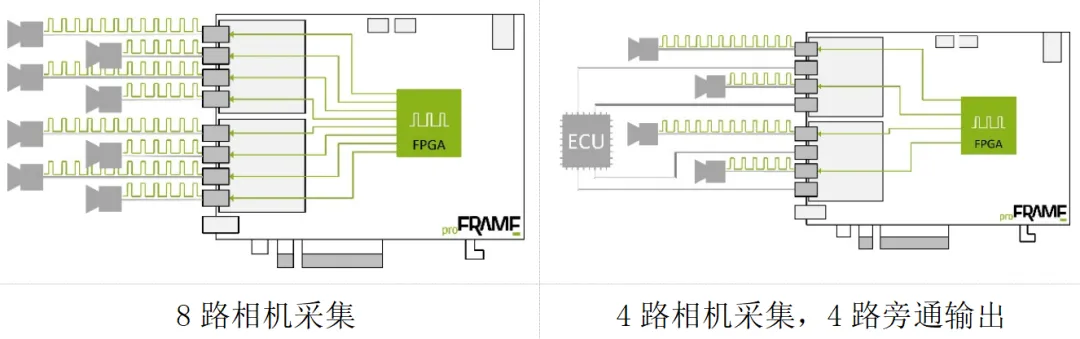
FPGA generation for proFRAME boards 40 MHz clock signal (25ns interval)The image is captured and injected into the image, and each frame can be labeled with theNanosecond time stamp (Timestamp)。
All connected cameras are triggered with this unified clock signal to realizeMicrosecond multi-phase machine synchronizationThis ensures consistent image timing and provides an accurate basis for subsequent image fusion and perceptual algorithms.
2. Synchronization of phase pulse signal triggering
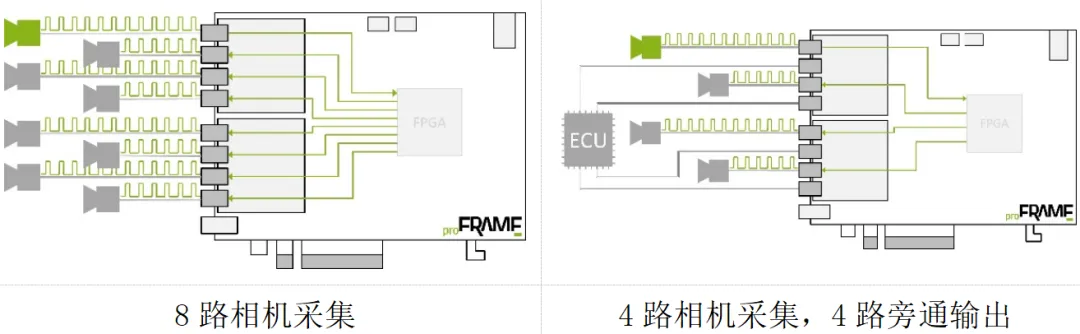
Some cameras support a built-in Trigger Pulse output, which can be used as a clock source for multiphase synchronization.When the main camera outputs a pulse signal, it is transmitted to the proFRAME FPGA via a coaxial cable, and then the FPGA distributes it to the other cameras, so that all the camerasActivate video capture at the same moment.It is also effective in minimizing time deviation.
3. External Trigger Synchronization
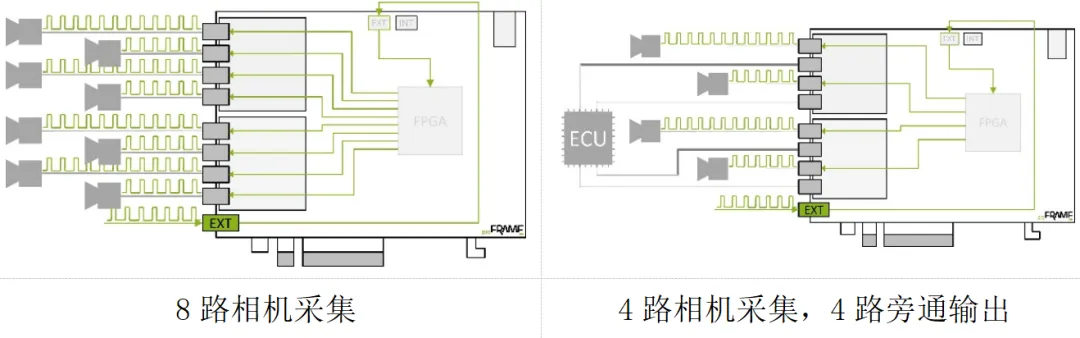
The proFRAME boards also support the use of other sensors (e.g., LiDAR, millimeter wave radar, IMU, GNSS, etc.).Cross-module time synchronization。Trigger signals from external devices can be distributed to multiple cameras through the board to realizeUniform time reference across sensorsThis ensures that heterogeneous perceptual data remains highly consistent when fused.
4. ECU bypass trigger synchronization
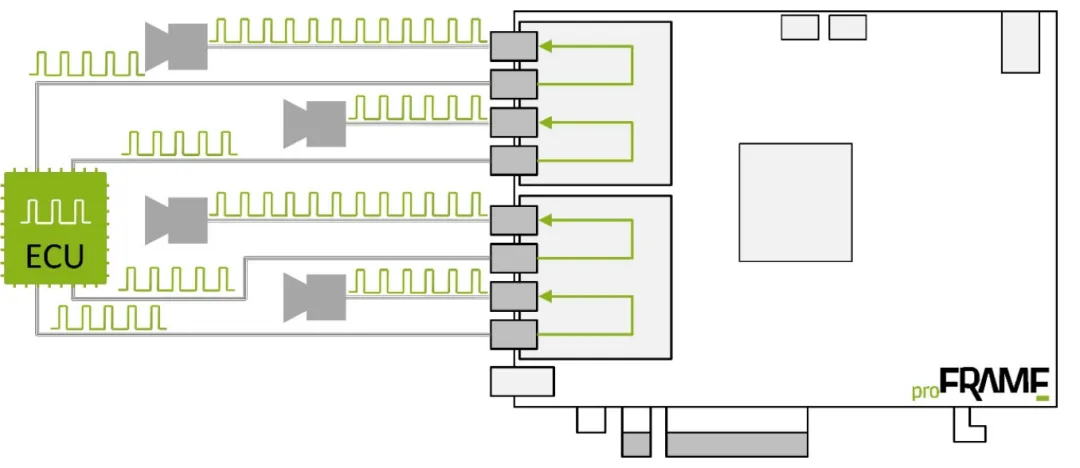
proFRAME SupportReal-time collection and bypass output mode (Bypass Mode)The video data can be output to both the host and ECU/Domain Controller at the same time.
The ECU can also send back the triggered clock signal through the reverse control channel to realize two-way time synchronization between the ECU and the camera, ensuring that the data stream (Video Stream) and control signals (I2C, GPIO) are fully aligned.
5. Time synchronization between multiple boards
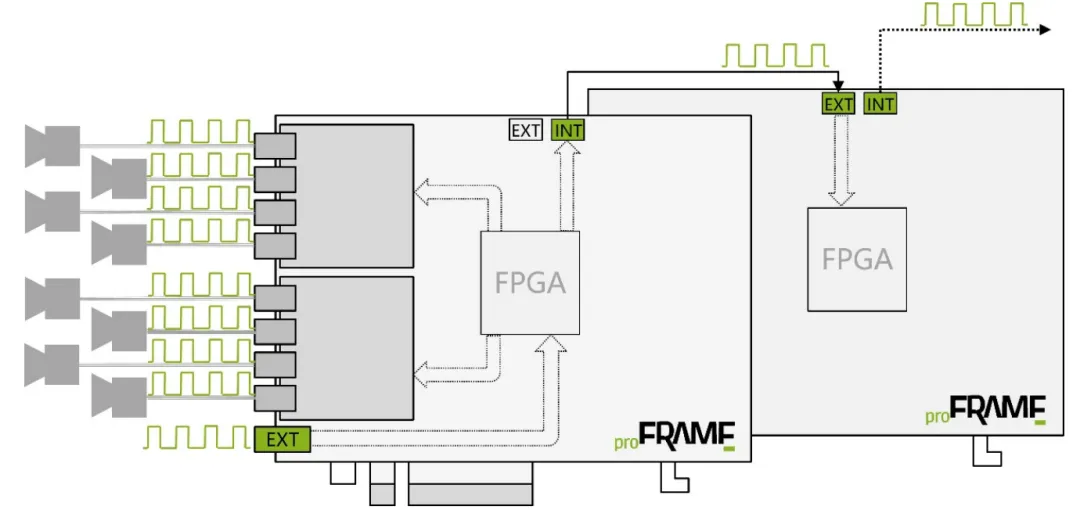
When more than 8 cameras are required for a video system, proFRAME supports multi-card linkage.Board-to-Board Internal/External Trigger Interface Shared FPGA clock signals to enableMulti-card synchronized triggeringThis ensures that the time error between all cameras is maintained at the microsecond level.
1. Three-camera time synchronization and image acquisition test
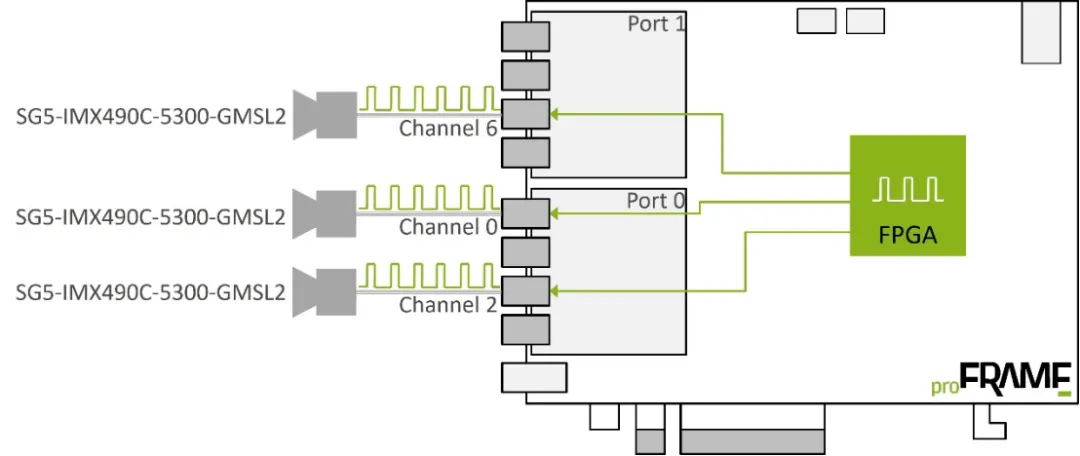
The proFRAME board connects to three Senyun cameras, model SG5-IMX490C-5300-GMSL2 (resolution 2880×1860, sample rate 30fps).The system is triggered by the FPGA clock signal built into the card to synchronize the exposure and image acquisition process of the three cameras.
- The test results are as follows:

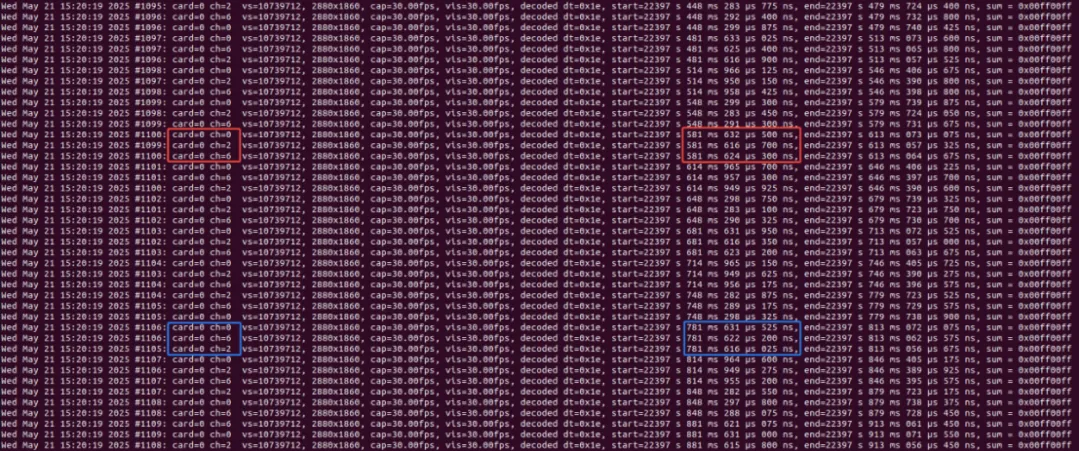
Synchronized triggering and exposure activation of the three cameras through the proFRAME card to successfully capture the image data.
As shown by the red and blue lines in the figure (the left side represents the acquisition channel, and the right side is the nanosecond time stamp of the current image frame), the time synchronization error among three cameras is as followsApprox. 15 microseconds (µs)The overall synchronization accuracy of the display is very high, which is sufficient to meet the experimental requirements of multi-phase machine perception and image fusion.
2. Three-camera synchronization and bypass image acquisition test
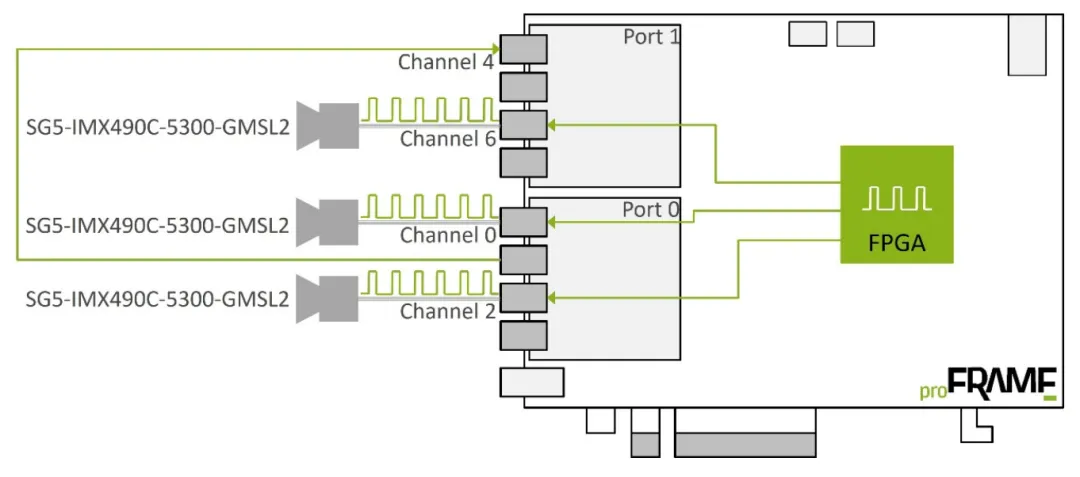
The proFRAME board connects three Senyun cameras, model SG5-IMX490C-5300-GMSL2 (resolution 2880×1860, capture rate 30 fps). The system triggers the synchronized exposure and image acquisition of the three cameras through the built-in FPGA clock signals on the board. At the same time, the bypass output signal of Channel 0 is connected to Channel 4 for acquisition to verify the bypass data content and time delay performance.
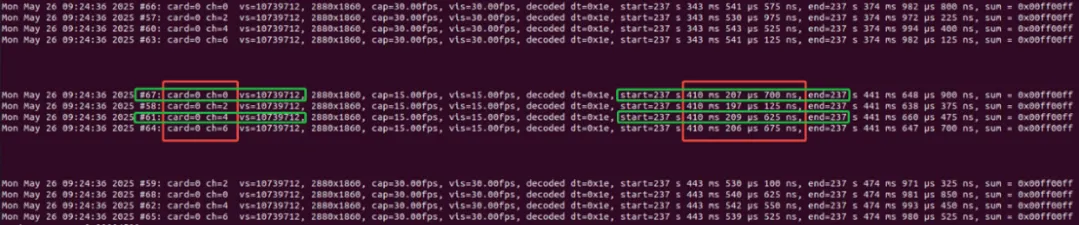
- The test results are as follows:The proFRAME card triggers the three cameras to synchronize to start exposure and acquire image data, as shown in the red and blue boxes in the figure (the left side is the acquisition channel, and the right side is the nanosecond time stamp of the image frame), the synchronization error between the three cameras.Approx. 15 microseconds (µs)The results are consistent with the previous test. Among them, Channel 4 is the bypass data channel of Channel 0, as shown in the green box in the figure (the left side is the capture channel, and the right side is the nanosecond time stamp of the image frame). Time Error between Bypass Image and Original ImageApprox. 2 microseconds (µs)It shows that proFRAME maintains high stability and very low latency in both simultaneous transmission and bypass capture.
 Want to make your ADAS and multi-sensor systems more efficient?
Acer proFRAME Modular Image Acquisition and Injection BoardsProvides scalable synchronization solutions to assist R&D teams in realizing microsecond timing and real-time data verification of multiphase machines, enhancing test efficiency and system stability.