Lack of Awareness: Significant Gaps Remain in CRA Requirements for Businesses
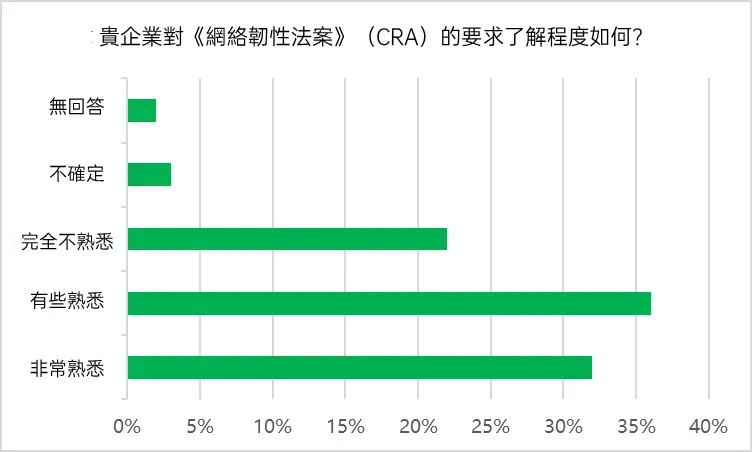
The data from the Internet of Things and OT Network Security Report 2025 shows a clear lack of understanding of CRA-related knowledge among organizations. Only about one-third (32%) of the respondents indicated that they fully grasp the specific requirements of the CRA; another 36% have not yet truly understood the content of the specification despite having conducted a preliminary survey; and the remaining 27% confessed that they are completely unfamiliar with the CRA, and they do not even understand whether they will be affected.
Due to the lack of awareness, the number of enterprises that have really started to establish a CRA compliance mechanism is even more limited. At present, only 28% enterprises have set up cross-departmental working groups to coordinate product, R&D, legal and security teams to prepare for CRA compliance; and another 14% enterprises have set up a dedicated team to take charge of the whole process of compliance implementation. However, as many as one-third (32%) of the organizations have yet to establish any kind of CRA working group, indicating that most organizations are still lagging behind in their CRA compliance preparations.
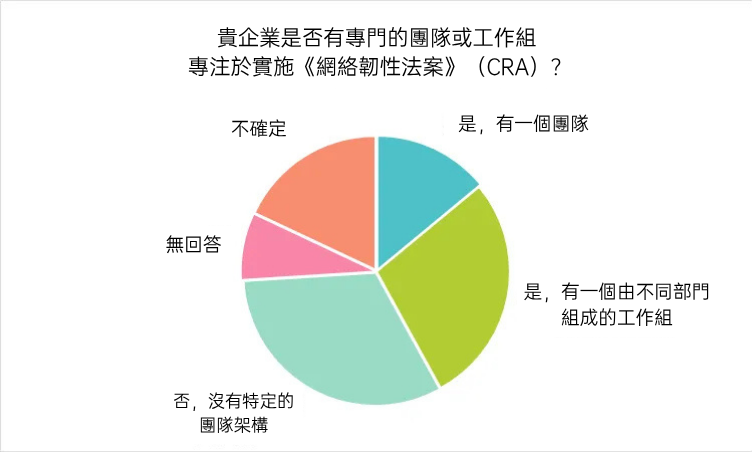
Overall, there are obvious gaps in enterprises' understanding of CRA, as well as large gaps in their internal governance and organizational readiness. Without accelerated investment in the future, it is highly likely that they will be subjected to compliance pressure and even market risks after the regulation officially comes into effect.
Slow progress of implementation
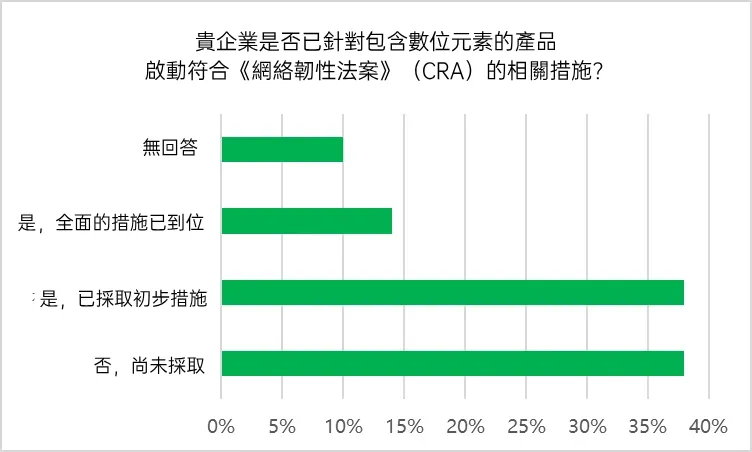
From the survey results, it is clear that companies are lagging behind in the actual implementation of the CRA. Only 14% enterprises have initiated complete and comprehensive compliance measures to ensure that their IoT devices, machines and systems comply with the CRA requirements. Another 38% have only made preliminary preparations, such as internal discussions or initial assessments, but have not yet established institutionalized processes. More than half of the remaining companies have yet to take any CRA-related action, indicating that the industry as a whole is still in the early stages of facing the new EU regulation.
In terms of policy formulation, the situation is not very optimistic either. Only 15% enterprises have formulated compliance policies specifically for CRA, which is obviously on the low side. In contrast, 34% respondents believe that the existing information security policies are sufficient to cover CRA requirements, but there may be a gap between this perception and the actual requirements. In addition, there are still 21% enterprises that have not included CRA in their compliance framework at all, showing that they still lack full understanding of the importance and impact of the new regulation.
Overall, the progress of the CRA has lagged far behind the mandatory entry into force of the regulation. As companies face the risk of not being able to import their products into the EU market, or even high penalties if they continue to delay, now is the critical time to accelerate the strengthening of internal policies and compliance processes.
Nearly 30% Companies Struggle with SBOM: Transparency Requirements the Biggest Bottleneck
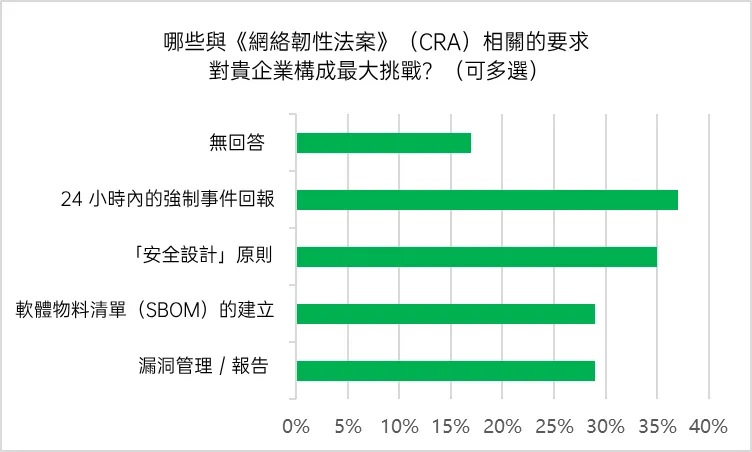
Among the CRA's various obligations, organizations generally found the requirement to report security incidents within 24 hours to be the most challenging, followed by the need to implement the principles of "secure by design" and "pre-designed security" at the product design stage. In particular, 29% of the respondents pointed out that the most difficult part of the requirement is to "establish a software bill of materials (SBOM) and continuously monitor all software components and vulnerabilities in the future.
SBOM (Software Bill of Materials) can be regarded as the software version of the "Bill of Parts," covering libraries, package dependencies, and version information, which is an important foundation for enhancing software transparency and shortening vulnerability analysis time. Without an SBOM, it is difficult for organizations to quickly determine whether a security vulnerability will affect their products, which can delay the time to fix it. Therefore, establishing a standardized, sustainably maintained SBOM process is a critical step in improving product resilience and strengthening security governance, especially in production environments where large numbers of devices are deployed and updates are frequent.
It is worth noting that although 44% enterprises have started to build SBOMs, only 12% have actually completed building SBOMs for all their products; another 32% have built SBOMs for only some of their products; 25% have not yet started, and another 25% of respondents even think that they will not be affected or have not yet understood the scope of the responsibility of SBOMs in the CRA. There are still 25% who have not yet started and another 25% who even think they will not be affected or do not fully understand the scope of SBOM responsibilities in the CRA.
Overall, SBOM has become a major sticking point for enterprises on the road to CRA compliance, showing that there is still a significant gap between organizations in terms of software asset transparency and vulnerability management processes. Starting SBOM construction now is still a critical time for enterprises to catch up with the CRA schedule.
Fuzzy division of safety responsibilities and unclear roles within enterprises
When asked who is responsible for ensuring compliance with the CRA, the majority of responses were highly dispersed, indicating that there is still a lack of consensus on where responsibility lies within the organization.
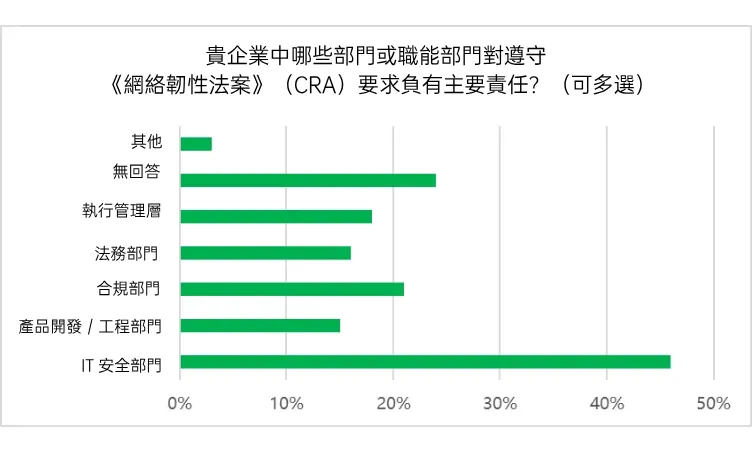
According to the survey results, about 46% enterprises have their CRA compliance work led by the IT security department, 21% are coordinated by the compliance department, 16% by the legal department, another 18% are directly led by the top management, and even 15% have assigned the CRA compliance responsibility to the product R&D team. On the whole, most enterprises have adopted a multi-departmental approach, but the boundaries of responsibility have not been clearly defined.
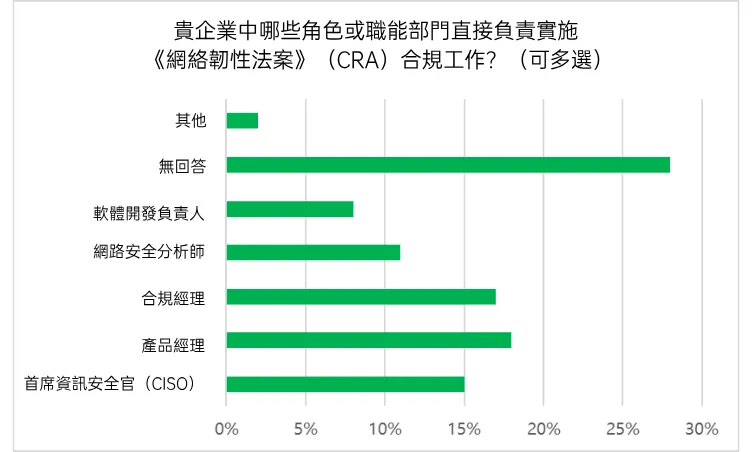
A similar fragmentation of roles was observed for specific responsible parties: 18% assigned CRA compliance responsibilities to product managers; 17% to compliance managers; 15% to CISOs (Chief Information Security Officers); 11% to security analysts; and 8% to software development executives. This distribution of roles reflects the potential for duplication, gaps, or cross-management between departments and functions in an organization's CRA compliance preparation.
In other words, although enterprises have begun to realize the pressure brought by CRA and try to establish internal responsibility chains, most of them have not yet formed a clear, consistent, and implementable configuration of authority and responsibility, and if they do not make timely adjustments in the future, it may cause bottlenecks in internal collaboration and compliance implementation after CRA is formally launched.
 If you would like to learn more about CRA regulatory requirements, the SBOM build process, or assess your organization's current compliance maturity, we can help you navigate through the ONEKEY Automated Security Analytics PlatformThe new system is designed to enhance product firmware and shorten compliance timelines to keep your IoT/OT system competitive in the face of the new EU regime in 2026!