summarize
About dSPACE
dSPACE is a global player in simulation and verification and an innovation leader in the aerospace and defense sectors. dSPACE offers a wide range of simulation and verification solutions covering the entire innovation chain from initial conception to support for mass production. dSPACE's simulation and verification solutions can be used in the areas of autonomous vehicles, electric vehicles, motors, battery systems, fuel cells, power electronics, charging infrastructure, etc. dSPACE also offers different types of simulation models supporting all development phases from functional design to ECU testing, power electronics, charging infrastructure, etc. dSPACE also offers different types of simulation models to support all development phases, from functional design to ECU testing.

Program Introduction
The importance of GNSS signals for autonomous driving lies in their ability to provide accurate, usable and reliable positioning solutions. Many applications, whether for V2X communication or autonomous driving function testing, require satellite-enabled vehicle position detection capabilities.
However, the availability of different GNSS systems varies and the quality of Global Navigation Satellite System (GNSS) signals is susceptible to various terrain effects (e.g., canyons, dense cities, overpasses), in addition to unintentional, intentional, or malicious spoofing of the signals. To ensure the robustness and suitability for daily use of applications in various test scenarios, more stable and high-performance GNSS simulators are required.
Program Components
The whole system consists of the following parts:
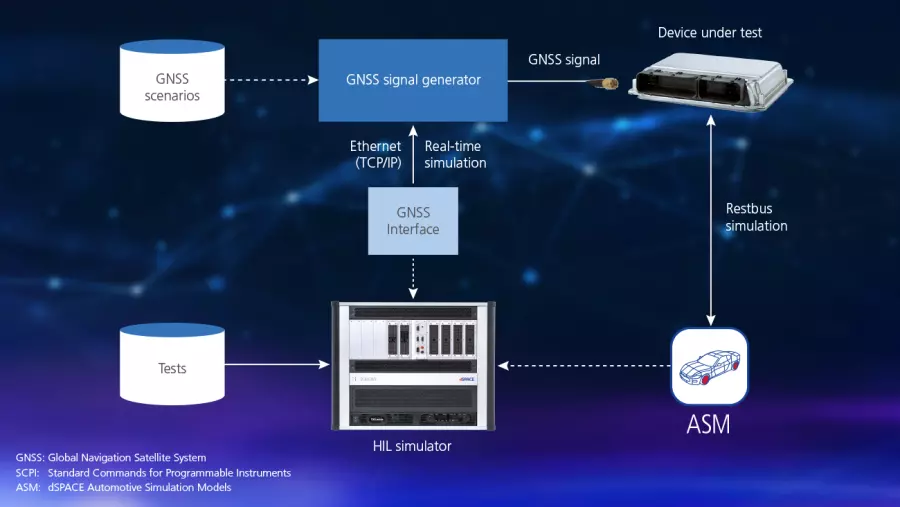
● HIL Simulator:HIL system with Automotive Simulation Model (ASM) for vehicle and traffic simulation
● GNSS blockset: Dedicated GNSS Emulator Interface Module for controlling Global Navigation Satellite System (GNSS) signal generators
●GNSS simulator GSG-8 GEN2:Generate GNSS scenes with specific requirements based on currently provided information such as geographic location, and provide vehicle position data in the form of RF signals.
●Automotive Simulation Model (ASM): ASM is a suite of tools for simulating internal combustion engines, vehicle dynamics, electrical components and traffic environments. Open Simulink models are used for model-based functional development and ECU testing on hardware-in-the-loop (HIL) simulators.
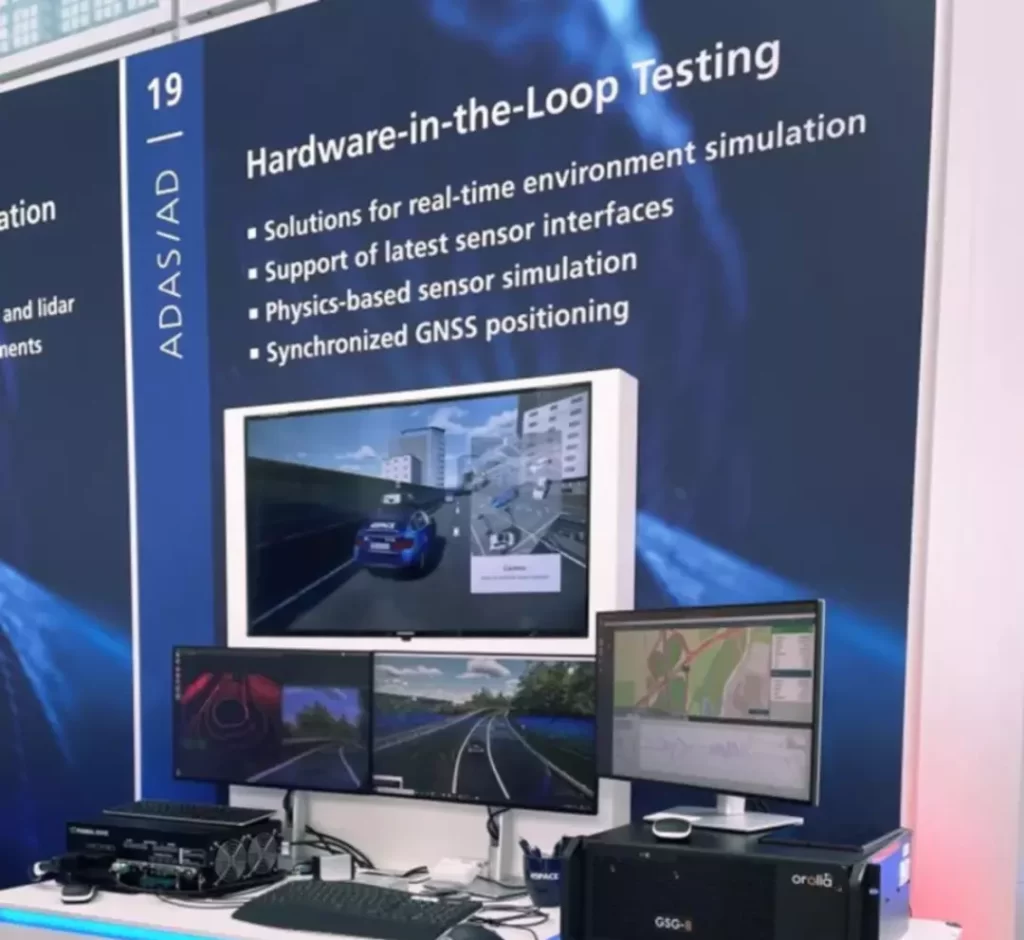
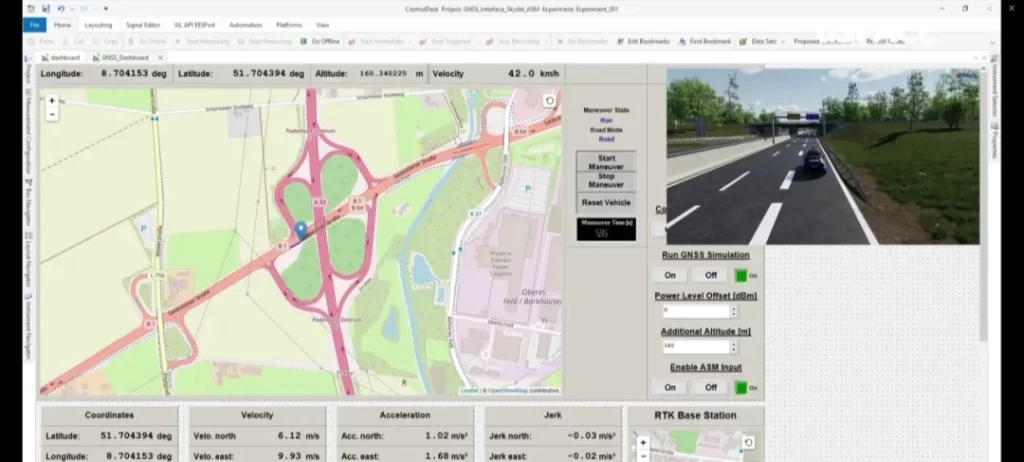
In this scheme, the HIL simulator can specify 3D paths and related scenes (top right), provide position information (latitude, longitude, altitude), 3-axis velocity, 3-axis acceleration, 3-axis plus acceleration, etc. in the HIL simulator (bottom), and optionally provide attitude information such as 3-axis angular velocity using the dSPACE ASM option, which can be transmitted in real time to the GNSS This information can be transmitted to the GNSS simulator in real time, and then simulated and transmitted to the device to be tested via RF.
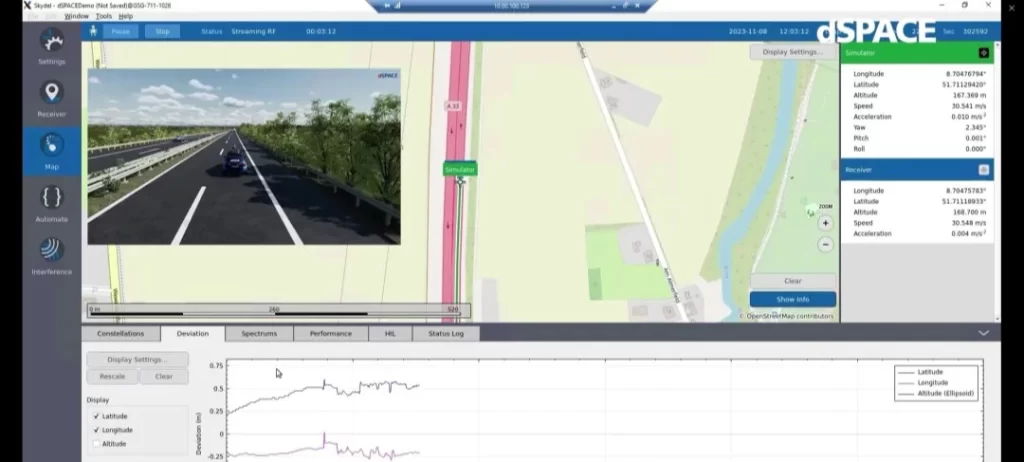
In the GNSS simulation process, we can observe the simulation data of GNSS simulator and GNSS to-be-tested parts (right side) in real time, and observe the positioning error and simulation position.During the simulation process, the interaction data between the GNSS simulator and the object to be tested are monitored in real time to analyze the positioning error, compare the simulated position with the actual position, and realize the precise evaluation of the performance.
With this solution, the GNSS test object is connected to the HIL model of the 3D simulation scenario. In this way, the performance and functionality of the device to be tested can be more completely tested in the HIL simulation scenario. It is possible to simulate diverse driving scenarios and environmental conditions without the need to conduct a large number of complex tests on real roads, which greatly improves the testing efficiency, and at the same time, it can more accurately evaluate the performance of the GNSS device to be tested under different conditions, which can provide powerful data support for its optimization and improvement.
efficacy
High-performance simulation of geolocation and satellite signals can be accomplished with the help of a GNSS simulator. After integrating the GNSS signal generator into the simulation environment and connecting it to the dSPACE Automotive Simulation Model (ASM), the module selects the predefined GNSS scene and controls the signal generator. In a typical test, the starting position, date, route, vehicle driving operation, etc. are first parameterized in the ASM model, and then the desired GNSS scene, e.g., specific satellite constellations (GPS, Galileo, GLONASS, BeiDou, etc.), and signal fading are selected. The signal generator prepares it based on the GNSS scene and provides it as a real RF signal to the equipment to be tested.
Learn more about our products
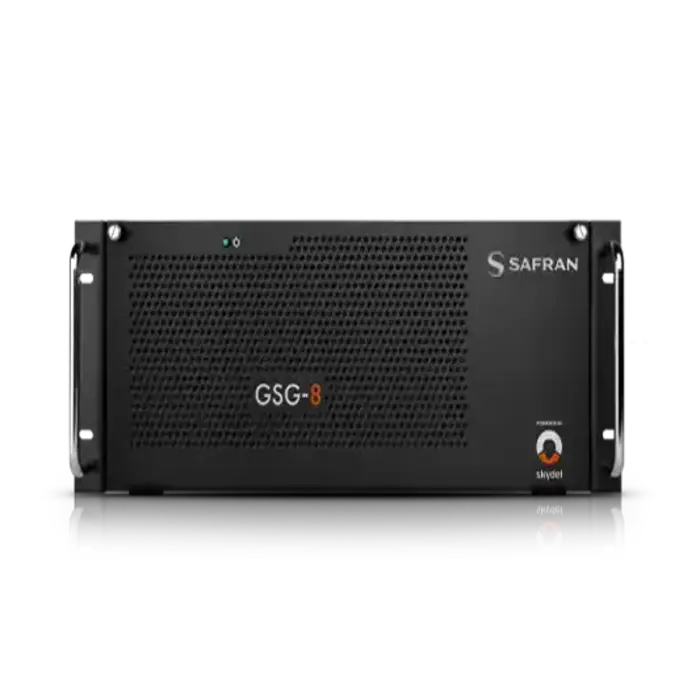
High-end GNSS Simulator GSG-8
- Panoramic satellite simulation - 1200 channels, no need to pay for channels
- Software Definition Architecture - Built-in CPU, GPU, SDR, Expandable and Upgradable
- Industry's lowest latency - HIL latency as low as 5ms
- High simulation iteration rate - 1000Hz simulation iteration rate
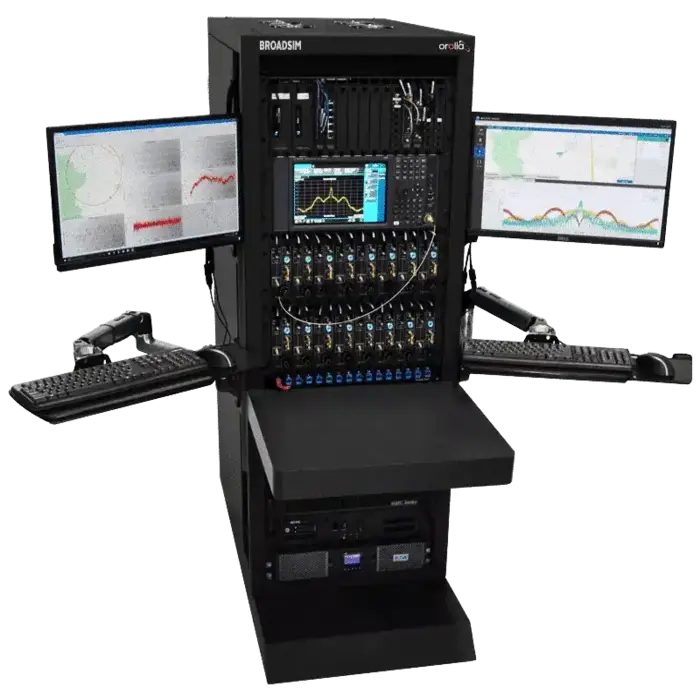
Skydel Anechoic GNSS simulator
- Automatic Antenna Mapping
- Automatic time delay calibration
- Automatic power loss calibration
- Software Definition Architecture SDA
If you are interested, you are welcome to follow us for more information about the article and contact us if you have any questions!