I. Preface
General Data Protection Regulation (GDPR)It is one of the most stringent data protection laws in the world, designed to ensure that businesses and organizations handle personal data appropriately and respect the privacy of individuals.
As long as the business hasCollection, processing or storage of personal data of EU citizensThe behavior of the company is bound by the GDPR.Failure to comply could not only result in high fines, but could also have a serious impact on your reputation and business.
For the automotive industry, from the development of ADAS (Advanced Driver Assistance Systems) to self-driving car testing.With so much image and sensory data at stake, it's important to understand and comply with the GDPR. In this article, we shareThe most common in the automotive industryFive GDPR Misconceptions
Misconception 1: Don't anonymize non-essential data?
One of the core principles of the GDPR is that "theData Minimization (Data Minimization)」,However, this concept is often misunderstood.By data minimization, we mean that companiesonly collect, process and retain personal data which are necessary for the fulfillment of the specified purposes,It must not be kept beyond demand or retained for too long.
However, this does not mean that anonymization can be skipped.For example:While it is true that a large number of vehicle images are required for the development of ADAS systems, in most cases only vehicle behavior and road condition data need to be analyzed.There is no need for a clear face or license plate.
If such image information is not relevant to the purpose of the development, it should still be anonymized to protect the security of the personal data and to avoid unauthorized use.

Misconception 2: There is a huge amount of data and the risk of identifying an individual is not high.
Many companies mistakenly believe that "with a large amount of data, it is difficult to identify individuals and the risk is naturally low".But this is not the case.
Even images taken in public spaces may involve personal data.and GDPR Default Enterprise無The Law of the People's Republic of China and the Law of the People's Republic of China on Prejudging Whether or Not Data Will Be Used by Others to Identify an Individual。
For example, if a third party (e.g., a researcher, media outlet, or AI platform)Comparative analysis of data for interest or other purposes.It is still possible to identify specific people, leading to privacy leakage.Therefore, no matter how large the data set is, anonymization and access control mechanisms must be implemented in advance.

Misconception 3: Encryption equals anonymization?
This is one of the most common misconceptions.Under the GDPR definition, "Encryption" is defined asPseudonymization, rather than true anonymization.Encryption only makes the data temporarily unrecognizable, but if one has the key or sufficient technical capability, theThere is still a chance that the original data can be restored.
In addition, encryption algorithms that are secure today may be broken in the future due to technological advances.Therefore.Encryption is not a substitute for anonymizationThe two are clearly differentiated in the statute.
Misunderstanding 4: Stickers with video reminders can be regarded as authorization.
Some companies put a "This vehicle is recording" sticker on their test vehicles.It is considered that the user's "consent" is obtained by openly informing the user.
However, under the GDPR requirements, data processing must be grantedExplicit Consent (Explicit Consent)。Simply posting a reminder or website announcement is only "passive notification" and does not constitute a valid authorization.
In the automotive industry scenario, ADAS imaging data often involves a large number of road users and vehicles.Obtaining written or verbal consent on a case-by-case basis is virtually impossible, making it all the more necessary to use anonymization techniques as an alternative.
Misconception 5: Data is only used within the company, so there is no need to anonymize it?
"Our data is only analyzed within the company, we don't have to anonymize it." This is wrong.
Even if the data is for internal use only, there are stillTwo major risks:
1. Data leakage due to external hacking
2. identification of specific individuals by internal staff under unauthorized circumstances
The GDPR is particularly stringent for sensitive locations (e.g., hospitals, places of worship, etc.), and any incident that results in the leakage of personal information, even if non-malicious, could result in fines and a crisis of trust.
Conclusion
Summarizing the five major misconceptions mentioned above, we can find that none of them can evade the core requirements of the GDPR.Even if the "Data Minimization Principle" is met, it does not mean that the anonymization obligation can be waived.
For the automotive industry, anonymization has long been more than just regulatory compliance, it'sProduct development quality and enterprise trustworthiness guarantee mechanism。
However, the challenge is real:
- Traditional blurring methods can easily damage image quality and cause distortion of AI model training data.
- Excessive masking reduces the value of the image for research and analysis;
- Regulatory requirements vary greatly from region to region, making it difficult for companies to balance speed and compliance.
Against such a backdrop, theEnterprises need more than just "coding data"; they need an anonymization solution that combines compliance, security and usability.。
💡 Brighter AI: The Optimal Balance of Law Enforcement Compliance and Image Usability
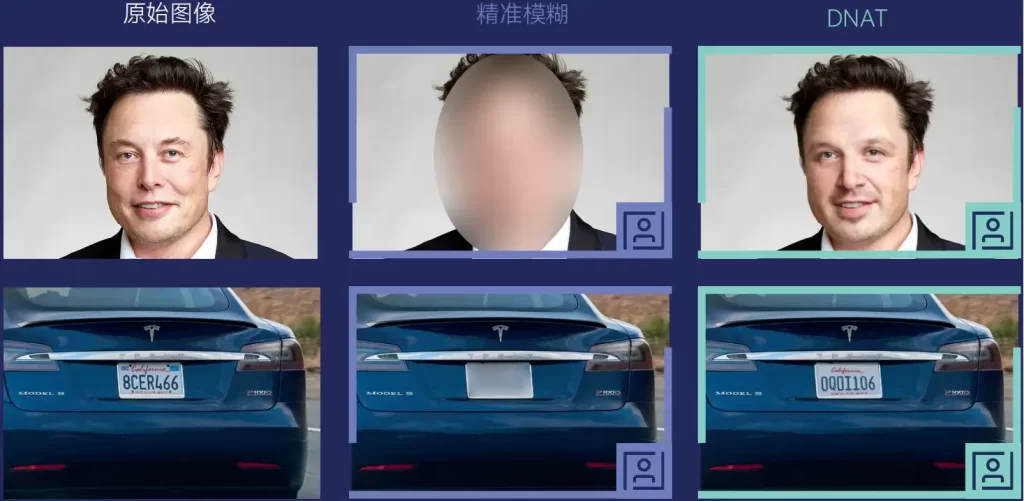
Brighter AI's "DNAT, Deep Natural Anonymization Technology" uses generative AI to automatically convert faces and license plates intoVirtual Alternative ImagesThe system eliminates identifiable information while maintaining the realism of the image and the structure of the data.
Unlike traditional mosaics or fuzzification, DNAT has the following advantages:
- High Accuracy - Accurately recognizes faces and license plate locations in multiple scenes.
- natural fidelity - Generates natural-looking virtual images that don't interfere with AI model recognition.
- Full Process Compliance - Fully compliant with GDPR and European data protection standards
- Highly expandable - Supports in-vehicle imaging, smart city monitoring, ADAS development, and many other applications.
Brighter AI not only helps companies to be "compliant", but also allows data to continue to create R&D and business value while remaining legal.
 Want to learn more?Autonomous Driving SolutionsWhat?
Hong Hong Electronics, together with Brighter AI, provides state-of-the-art data anonymization and image compliance solutions to help companies balance regulatory compliance and data availability when developing ADAS, autonomous vehicle and intelligent transportation applications.If you would like more informationFeel free to contact us now!Or schedule an appointment for a personalized consultation and we will be happy to assist you.
Honghong will provide you with any support you need!
Our professional Honghong team will be the first to respond and provide you with the best service to solve all your problems.