AWG in Quantum Computing
Precision is always important in research, and few areas of research require more precision than quantum research. The Institute for Quantum Optics and Quantum Information at the University of Innsbruck in Austria needs an arbitrary waveform generator (AWG) to generate a wide variety of signals for their research.
I. RadioFrequency
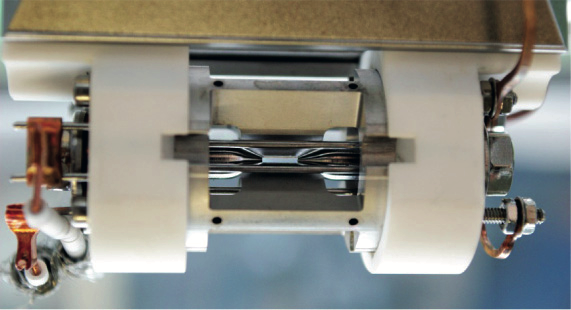
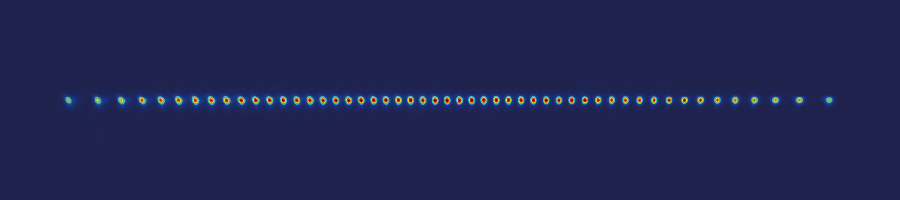
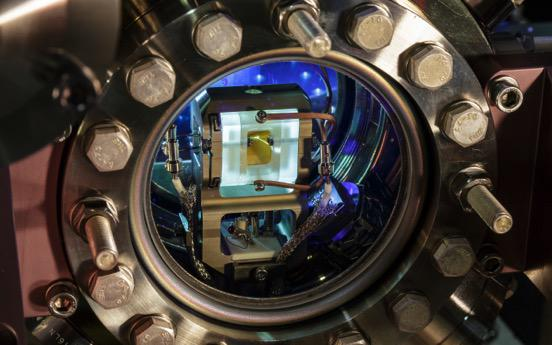
The first application is the application of multi-frequency signals in the RF range. Each frequency component is realized using sinusoidal functions. The resulting differential signals are used to simultaneously process individual ions trapped in the ion quantum simulator. The ion trap is shown in Fig. 1.
Christine Maier, a researcher at the institute, explains: “We are performing quantum simulations of trapped cool calcium ions, where the ability to address single ions is crucial. To do this, we send laser beams through an acousto-optic deflector (AOD). The frequency of the radio-frequency signal applied to the AOD crystal defines the deflection angle of the laser beam, and it determines where the ions in our linear ion string are addressed.
AWG now allows us to generate multi-frequency signals, even if each signal has an arbitrary amplitude, which means that we can now treat multiple ions in the ion string simultaneously. One advantage of this is that the experiment is faster because we don't need to process each ion one by one.
It also opens up a completely new field of research: Previously we could only investigate undisturbed energy transport in ion chains, but by solving single ions of arbitrary strength it means that we can now create arbitrary potential barriers and learn about energy transport in disordered quantum systems. However, by solving single ions of arbitrary strength means that we can now create arbitrary potential barriers and learn about energy transport in disordered quantum systems. the AWG even allows us to program time-varying potentials to study dynamic disorder.”
Two,Destructive Interference
The second application is the elimination of unwanted frequency mixing items through destructive interference, such as when applying multi-frequency signals to an acousto-optic modulator. When applying multi-frequency signals, several sum and difference frequency components appear and are eventually mapped onto the optical signals on the sent ions.
This raises two problems: firstly, this loses power from the frequency components that are actually needed, and secondly, the mixing term may reach certain resonance frequencies of the ion chain and destroy the quantum model that is trying to be simulated.
Using the Spectrum AWG allows us to eliminate these unwanted items through destructive interference in the real-time measurement and feedback loop.” Because of the diversity of applications, it is important to have an AWG that is easy to program using a PC so that the output can be easily customized for each application.
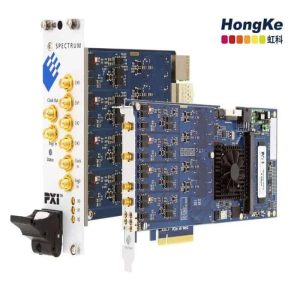
The Spectrum M4i.6631-x8 shown in Figure 5 was chosen because it is located on a PCI Express card that can be integrated into and directly driven by a PC.
Three,About AWG M4i.6631-x8
The M4i.6631-x8 is highly configurable, featuring two AWG channels, trigger option selection, external clock inputs, multiple and gated playback modes, loop functions, and even the ability to combine two trigger inputs via a logic gate.
This, combined with the high resolution and 1.25 GS/s sampling rate, makes it a logical choice for providing flexibility for projects owned today and, more importantly, for any future needs with just one instrument.
Understanding the M4i.6631-x8 specification >>Go to page
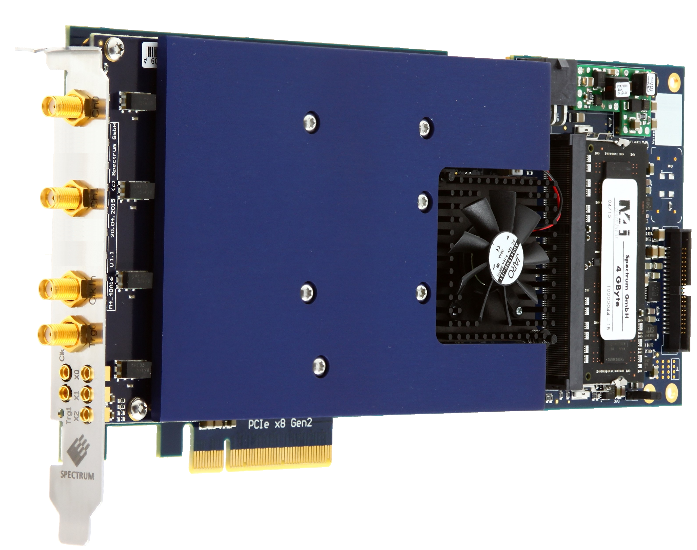
The Spectrum AWG can replay loaded waveforms from its 4 GB internal storage at speeds of up to 1.25 GS/s. The Spectrum AWG can also be used as an analog output signal with defined offsets and amplitudes. Convert digital signals to analog output with defined offsets and amplitudes using 16-bit D to A conversion to provide fine signal detail that mimics the real world.
Any waveform can be replayed from a previously captured waveform as a computational or analog waveform from DC to 400 MHz. It has a unique FIFO streaming feature that makes it possible to generate arbitrary waveforms for hours at a time, unlike other AWGs, which have reduced signal playback time due to limited on-board memory. This allows tests to be conducted over a longer period of time.
Want to know more about our products? Feel free to contact us!
Join line>>Contact Us