
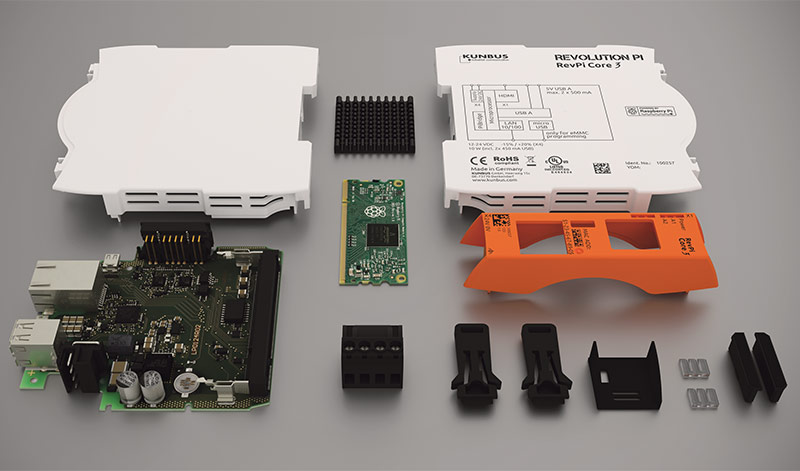

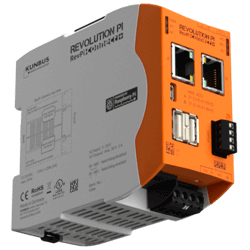
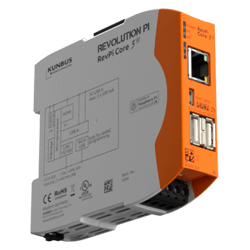
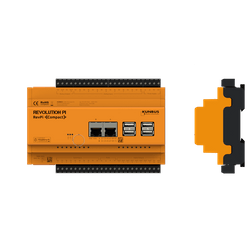
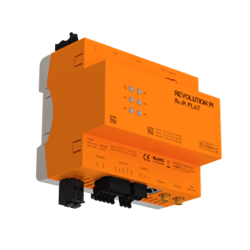
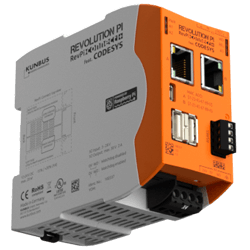
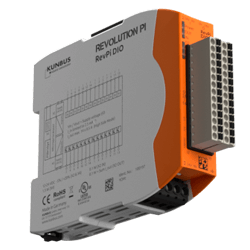
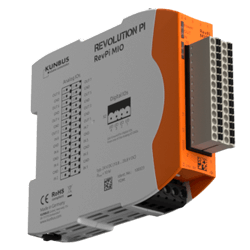
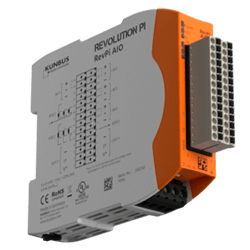
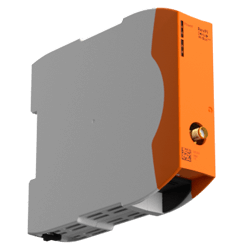
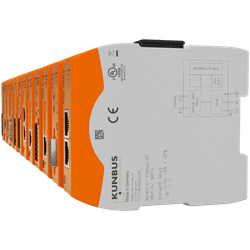
 Industrial package with IP20 protection rating; wide temperature range from -40 to +55°C; tested to industrial standards (EN61131-2 and IEC 61000-6-2) including EMI, surge, burst, and ESD polarity protection up to 4KV/8KV. Modular, flexible and expandable, DIN-rail mounting, with a range of modules such as expansion IOs and gateways connected via simple connectors for ease of use. The Industrial Raspberry Pi is installed with a LINUX-based Rasbian system with real-time patches, it is a real-time system with some internal software integration and a separate configuration software Pictory. The Industrial Raspberry Pi uses 24V power supply commonly used in industry, which is more stable, and is equipped with load protection and so on.
 The core of the Industrial Raspberry Pi and the ordinary Raspberry Pi computing module are exactly the same, both are BCM CPU, Raspberry Pi 1 generation is BCM2835 CP chip, single-core, 700Mhz, 500M RAM and 1G flash memory, and the Raspberry Pi 3 generation is BCM2837 CPU chip, 4-core, 1.2Ghz, 1G RAM and 4G ROM. The Raspberry Pi 3+ version is the BCM2837 CPU chip, with the same configuration as the 3rd generation, but with new 8, 16, 32G ROM versions to choose from.
Industrial Raspberry Pi can be used in temperatures from -40 to 55℃, compared to ordinary Raspberry Pi, it has been designed with a wider temperature range, at 65℃, Industrial Raspberry Pi can also run, but it can't run at full speed, it will be downclocked, and the frequency may be downclocked to 0.4GHz. In addition, Industrial Raspberry Pi's own casing design has taken into account the heat dissipation, with ventilation holes at the top and bottom of the plastic casing, and horizontal mounting to ensure that air can flow through RevPi modules and cool electronic devices (the chimney effect). The horizontal mounting ensures that air can flow through the RevPi module and cool the electronics (the chimney effect). Alternatively, we can install a fan in the control cabinet or water cooling, etc. For higher cooling requirements, the supplier can also provide OEM customized designs.
Industrial Raspberry Pi is widely used in various fields of industry with its open source characteristics. At present, the industrial Raspberry Pi is used in more fields such as data collection and uploading, small control, combined with software as soft PLC, gateway to industrial IoT, and can also be used for some edge computing applications, etc. The industrial Raspberry Pi has been widely used in various industries such as automotive and aerospace, industrial automobile, and automotive.
Industrial Raspberry Pi is combined with third-party software to be used as a PLC, such as Codesys, LogiCAD and other software, which is essentially a soft PLC functionality, installing third-party software runtime in the Industrial Raspberry Pi, and configuring the software to run the soft PLC capability can be used as a master station for EtherCAT, Ethernet/IP, CANopen, and other protocols. EtherCAT, Ethernet/IP, CANopen and other protocols.
Industrial Raspberry Pi itself can expand the IO module to directly collect some digital analog data; furthermore, Industrial Raspberry Pi itself has Modbus function, which can act as the master and slave of Modbus RTU and TCP, and can collect Modbus data; finally, Industrial Raspberry Pi can expand its series of gateway modules, which include some mainstream field bus and industrial Ethernet, such as Profibus, CANopen, Profinet, Ethernet/IP, EtherCAT, etc., and can collect data of various control layer networks in the industrial field through the gateway. Profibus, CANopen, Profinet, Ethernet/IP, EtherCAT and so on, can collect data from various control layer networks in the industrial field through the gateway.
The core module of the Industrial Raspberry Pi connects to our expansion modules via PiBridge or ConBridge, which are internal communication. The modules are DIN-rail, and the PiBridge or ConBridge are plug-in connectors, making them very easy to connect.
RevPi allows users to write their own programs, which can be run on the Raspberry Pi 4B. If it is a pure software program (without calling the hardware), it can be directly ported to the software under the Linux environment. If the program uses hardware such as IO, it needs to be modified for the hardware.
High-speed computing depends on hardware and software, the highest configuration of RevPi is 1GB RAM+32GB ROM for hardware, and software depends on user's program. Regarding the sampling frequency, the RevPi DI module has a maximum sampling rate of 2kHz, which can capture the data from the encoder, and how to handle it depends on the user's program.
RevPi does not have built-in NVRAM, so after an accidental power failure or reboot, the data is stored on eMMC. In addition to saving data via USB connection, users can also burn programs or save data files via SD card.
